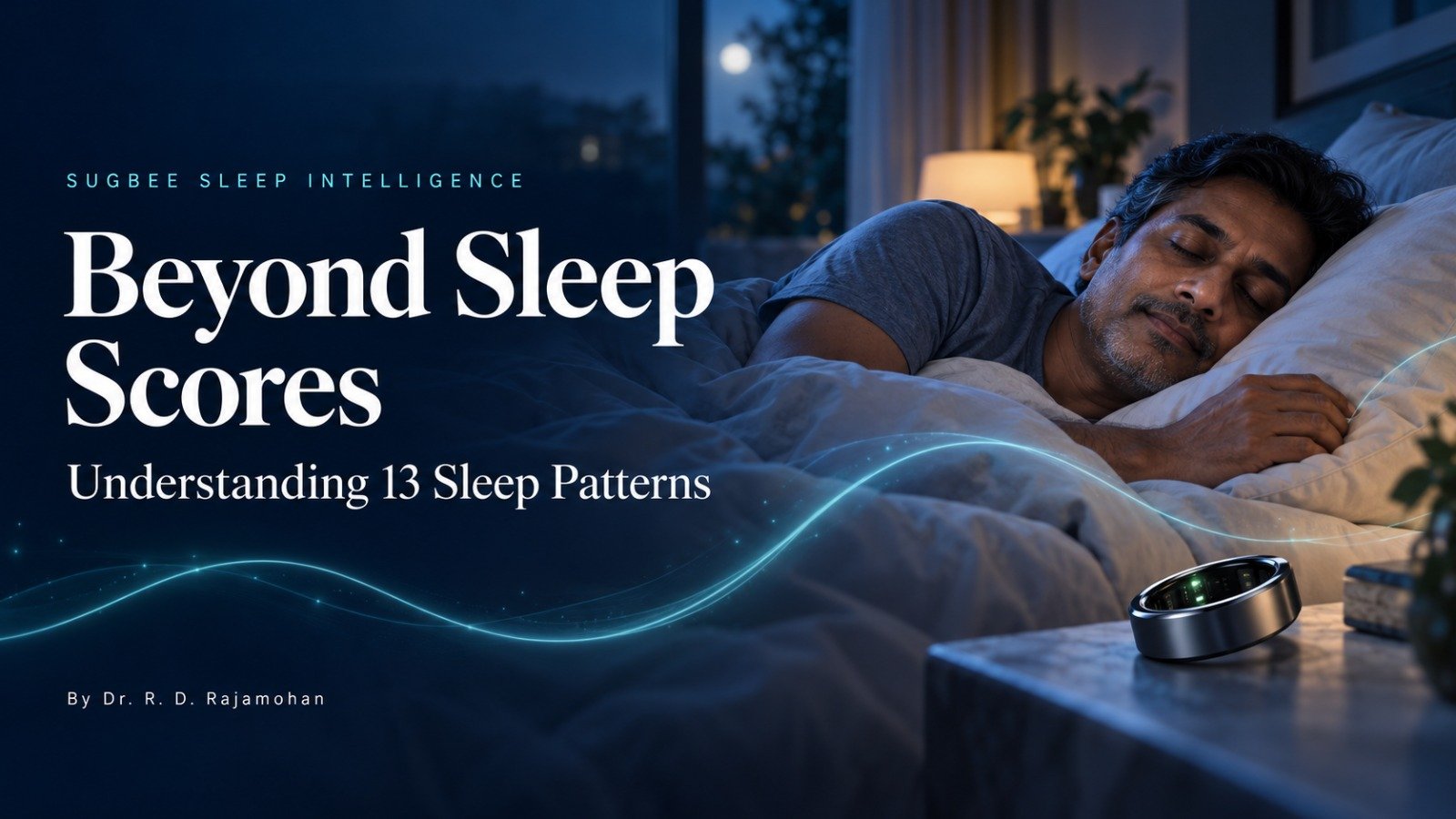
Beyond Sleep Scores: How Sugbee’s Health Intelligence Engine Understands 13 Sleep Patterns
Your Sugbee Smart Ring does more than tell you how long you slept. It helps you understand the patterns behind your sleep.
By Dr. R. D. Rajamohan
Consultant Diabetologist | Founder, Sugbee
Why does understanding sleep matter?
Have you ever slept for eight hours and still woken up feeling exhausted?
Or slept for six hours and wondered why you felt unusually energetic?
The answer is that sleep quality depends on much more than duration alone.
Your sleep timing, interruptions, sleep stages, body temperature and consistency all contribute to how well you rest.
This is where Sugbee’s proprietary Health Intelligence Engine (HIE) comes in.
The Sugbee Smart Ring collects information about your sleep, movement and physiological measurements throughout the night.
Our HIE technology is designed to analyse these measurements over time, compare them with your personal baseline and identify meaningful lifestyle patterns.
As part of our proprietary technology and patent-filing programme, we have developed a framework covering 13 different sleep patterns.
Let’s understand each one.
- Sleep Onset Delay — Why Am I Taking So Long to Fall Asleep?
What does it mean?
Sleep onset delay means taking longer than usual to fall asleep after going to bed.
You may lie down at 10:30 PM but remain awake until midnight.
Why does it happen?
Common reasons include psychological stress, late caffeine consumption, irregular sleep schedules, evening screen use and an uncomfortable sleeping environment.
How can you improve it?
Maintain a consistent bedtime, avoid caffeine during the late afternoon and evening, and develop a relaxing bedtime routine.
How Sugbee HIE helps: By examining estimated sleep onset and bedtime patterns across several nights, HIE is designed to identify repeated delays rather than focusing on one isolated night.
- Fragmented Sleep — Why Do I Keep Waking Up?
What does it mean?
Fragmented sleep refers to repeated awakenings or interruptions during the night.
You may spend eight hours in bed but experience several periods of wakefulness.
Why does it happen?
Stress, environmental noise, nighttime urination, certain medications and sleep-related breathing disorders can contribute.
How can you improve it?
Maintain a comfortable sleeping environment, limit unnecessary disturbances and seek medical advice if frequent awakenings persist.
How Sugbee HIE helps: The framework examines estimated awakenings and movement-related interruptions to identify recurring sleep fragmentation.
- Short Sleep Duration — Am I Getting Enough Sleep?
What does it mean?
Short sleep duration occurs when you repeatedly sleep for fewer hours than your body requires.
Most adults generally need seven to nine hours of sleep.
Why does it happen?
Long working hours, late bedtimes, early waking, family responsibilities and irregular routines are common contributors.
How can you improve it?
Protect sufficient time for sleep, establish a regular schedule and reduce activities that unnecessarily delay bedtime.
How Sugbee HIE helps: It is designed to identify repeated short-sleep patterns and compare your sleep duration with your usual routine.
- Long Sleep Duration — Can Sleeping Too Much Be a Concern?
What does it mean?
Long sleep duration refers to consistently sleeping longer than usual.
Occasionally sleeping longer after a demanding week is normal.
Why does it happen?
Sleep deprivation, illness, medication effects, poor sleep quality and some medical conditions can contribute.
How can you improve it?
Maintain regular sleep timing and assess whether you feel refreshed after waking. Persistent excessive sleepiness deserves medical evaluation.
How Sugbee HIE helps: The framework looks for repeated unusually long sleep periods and identifies changes from your typical sleep duration.
- REM Imbalance — Understanding Your Dream Sleep
What does it mean?
REM, or Rapid Eye Movement sleep, is a normal sleep stage associated with dreaming and important aspects of memory and emotional processing.
REM imbalance refers to an unusual estimated proportion of REM sleep.
Why does it happen?
Irregular sleep schedules, alcohol, certain medications and interrupted sleep may influence REM patterns.
How can you improve it?
Maintain sufficient sleep duration, reduce alcohol consumption and follow consistent sleeping hours.
How Sugbee HIE helps: The framework examines estimated REM proportions over multiple nights to identify recurring changes.
Smart rings estimate sleep stages indirectly; these estimates are not equivalent to clinical polysomnography.
- Deep Sleep Deficit — Is My Body Getting Enough Restorative Sleep?
What does it mean?
Deep sleep is a stage of non-REM sleep associated with important restorative physiological processes.
A deep sleep deficit pattern indicates a repeatedly low estimated proportion of deep sleep.
Why does it happen?
Ageing, sleep disruption, alcohol consumption and irregular sleep schedules may influence deep sleep.
How can you improve it?
Exercise regularly, maintain consistent sleeping hours and avoid alcohol close to bedtime.
How Sugbee HIE helps: It is designed to analyse deep sleep estimates over several nights and recognise recurring reductions.
- Circadian Drift — Is My Body Clock Changing?
What does it mean?
Your circadian rhythm is your body’s internal biological clock.
Circadian drift refers to a gradual shift in your usual sleep timing.
Why does it happen?
Late-night work, inconsistent schedules, travel and irregular exposure to daylight can contribute.
How can you improve it?
Maintain a regular wake-up time and obtain natural morning daylight.
How Sugbee HIE helps: By examining changes in sleep timing relative to your personal baseline, the framework can identify shifts in your usual sleep–wake routine.
- Late Chronotype Shift — Am I Becoming a Night Owl?
What does it mean?
Chronotype describes your natural preference for sleeping and waking earlier or later.
A late chronotype shift pattern identifies repeatedly late sleep onset.
Why does it happen?
Personal biological preferences, late-night activities, work schedules and evening light exposure may contribute.
How can you improve it?
If earlier sleep is necessary, gradually adjust your bedtime and morning routine.
How Sugbee HIE helps: It examines sleep onset times across multiple nights to identify consistently late sleeping patterns.
Sleeping late is not automatically unhealthy if sleep remains adequate and consistent.
- Social Jetlag — Why Do Weekends Affect My Sleep?
What does it mean?
Social jetlag occurs when your sleep schedule differs significantly between working days and days off.
For example, you might sleep at 10:30 PM on weekdays but at 1:30 AM during weekends.
Why does it happen?
Social activities, late-night entertainment and compensating for insufficient weekday sleep are common reasons.
How can you improve it?
Try to maintain reasonably consistent sleep and wake times throughout the week.
How Sugbee HIE helps: It is designed to compare weekday and weekend sleep timing and identify substantial differences.
- Low Sleep Efficiency — Am I Actually Sleeping While in Bed?
What does it mean?
Sleep efficiency describes the percentage of time spent in bed that is actually spent sleeping.
If you spend eight hours in bed but sleep for only six hours, your sleep efficiency is 75%.
Why does it happen?
Difficulty falling asleep, frequent awakenings and spending excessive time awake in bed may reduce sleep efficiency.
How can you improve it?
Maintain regular sleeping hours and avoid prolonged stimulating activities in bed. Persistent insomnia may benefit from structured treatment.
How Sugbee HIE helps: It is designed to examine estimated sleep time relative to time in bed and identify recurring reductions in sleep efficiency.
- Sleep-Breath Irregularity — Does My Breathing Change During Sleep?
What does it mean?
Breathing naturally changes during sleep.
However, repeated irregularities in breathing-related signals may sometimes warrant further evaluation.
Why does it happen?
Nasal congestion, respiratory illness and sleep-disordered breathing can influence nighttime breathing patterns.
How can you improve it?
Maintain healthy sleep habits and seek medical assessment if you experience loud snoring, witnessed breathing pauses or excessive daytime sleepiness.
How Sugbee HIE helps: The framework includes analysis of breathing-related variations estimated from supported physiological signals.
This pattern does not diagnose obstructive sleep apnoea.
- Thermal Disturbance — Is Temperature Affecting My Sleep?
What does it mean?
Your body temperature changes naturally throughout the night.
Thermal disturbance refers to unusual overnight changes in skin-temperature patterns.
Why does it happen?
Room temperature, illness, environmental conditions and normal physiological variations can contribute.
How can you improve it?
Maintain a comfortable sleeping environment and monitor unusual changes alongside symptoms.
How Sugbee HIE helps: The framework examines overnight skin-temperature trends and compares them with your usual patterns.
- Late Screen Exposure — Is My Phone Delaying Sleep?
What does it mean?
Late screen exposure refers to using your phone or other screens shortly before bedtime.
Why does it happen?
Social media, entertainment, work messages and habitual phone use often extend into bedtime.
How can you improve it?
Reduce stimulating screen activities before sleep and establish a screen-free wind-down routine.
How Sugbee HIE helps: This optional framework pattern can relate phone-usage information to sleep timing when the required data is available.
Unlike sleep movement and physiological measurements, phone usage cannot be determined directly from the ring.
What Makes Sugbee Sleep Intelligence Different?
A conventional sleep tracker may display your sleep duration, stages and a score.
Sugbee HIE is designed to go further by examining 13 different sleep-related patterns over time, using your personal baseline rather than treating every night independently.
The goal is to help you understand your sleep habits and recognise changes that may deserve attention.
Sugbee Smart Ring + Health Intelligence Engine: From sleep tracking to understanding sleep patterns.
A common closing message for all three blogs
28 Lifestyle Patterns. One Health Intelligence Engine.
Your Sugbee Smart Ring collects supported physiological and lifestyle measurements.
Sugbee’s proprietary Health Intelligence Engine is designed to transform those measurements into meaningful insights by identifying patterns across three areas:
13 Sleep Patterns | 7 Stress Patterns | 8 Activity Patterns
The HIE framework incorporates personal baseline comparisons so that changes can be interpreted in the context of an individual’s usual patterns.
Our vision is to move beyond simply displaying health numbers and help people better understand their everyday lifestyle.
Sugbee — From Health Monitoring to Health Intelligence.
These insights are intended for lifestyle awareness and do not replace medical diagnosis or professional healthcare advice.