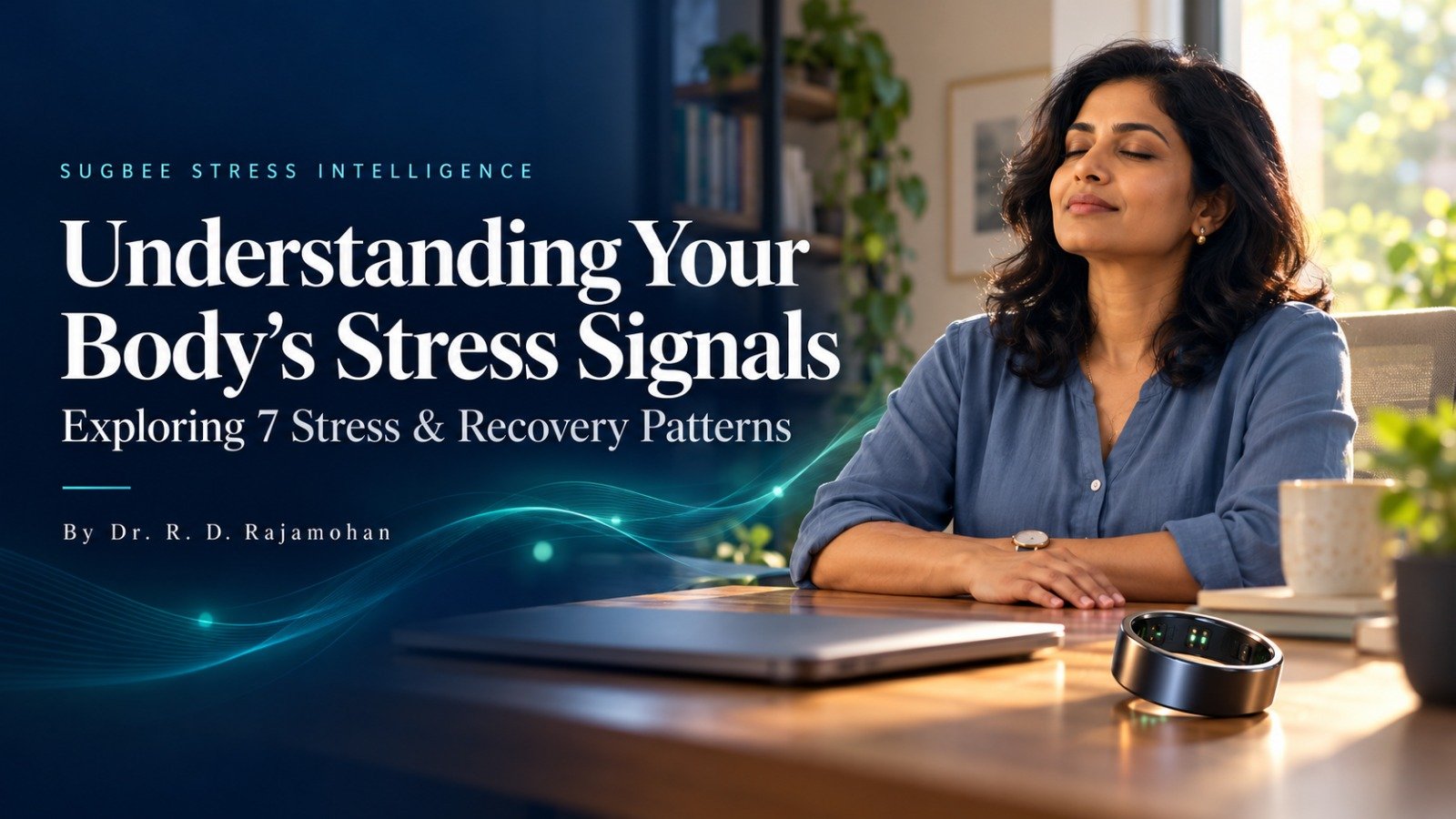
Understanding Your Body’s Stress Signals: The 7 Patterns Behind Sugbee Stress Intelligence
Stress is not always something you feel. Sometimes, changes in your body’s physiological measurements tell a different story.
By Dr. R. D. Rajamohan
Consultant Diabetologist | Founder, Sugbee
Can your smart ring help you understand stress?
Stress is part of everyday life.
A demanding working day, insufficient sleep, intense exercise or illness can all influence your body’s physiological responses.
Your Sugbee Smart Ring collects supported measurements such as heart rate and heart rate variability.
The proprietary Sugbee Health Intelligence Engine (HIE) is designed to analyse physiological trends and recognise patterns associated with stress and recovery.
Our HIE framework includes seven stress-related intelligence patterns.
These patterns describe physiological associations; they do not independently diagnose emotional or psychological stress.
- Acute Stress Burst — Why Does My Body Suddenly React?
What does it mean?
An acute stress burst refers to a sudden change in physiological activity that may accompany increased physical or emotional demands.
Why does it happen?
Anxiety, excitement, physical exertion, pain and unexpected events may produce changes in heart rate and autonomic activity.
How can you improve it?
Take short breaks, practise slow breathing and identify situations that repeatedly leave you feeling overwhelmed.
How Sugbee HIE helps: The framework is designed to identify abrupt changes in selected physiological measurements.
Its original blueprint includes GSR-based measurements, which require additional hardware and are not available from the current ring.
- Emotional Fatigue — Why Do I Feel Mentally Exhausted?
What does it mean?
Emotional fatigue describes a sense of mental exhaustion after prolonged emotional or psychological demands.
Why does it happen?
Work pressure, inadequate rest, ongoing responsibilities and insufficient recovery may contribute.
How can you improve it?
Prioritise sleep, maintain regular breaks, engage in relaxing activities and seek professional support when symptoms persist.
How Sugbee HIE helps: The framework includes an experimental pattern examining physiological trends that may accompany fatigue.
A smart ring cannot determine someone’s emotional state from physiological signals alone.
- Autonomic Overdrive — Is My Body Staying in a High-Alert State?
What does it mean?
Your autonomic nervous system helps regulate automatic functions such as heart rate and digestion.
Autonomic overdrive is the framework’s term for patterns suggesting altered autonomic regulation.
Why does it happen?
Physical exertion, inadequate recovery, illness, medication effects and psychological stress can influence autonomic measurements.
How can you improve it?
Maintain adequate sleep, practise relaxation techniques and balance exercise with recovery.
How Sugbee HIE helps: The blueprint includes analysis of heart-rate-variability characteristics to identify changes in autonomic-related patterns.
HRV cannot independently diagnose sympathetic overactivity.
- Thermal Stress — Is My Body Experiencing Heat-Related Strain?
What does it mean?
Thermal stress refers to physiological strain associated with heat exposure or increased demands on temperature regulation.
Why does it happen?
Hot weather, intense exercise, dehydration and inadequate cooling can contribute.
How can you improve it?
Maintain appropriate hydration, reduce excessive heat exposure and rest when necessary.
How Sugbee HIE helps: It is designed to examine changes in skin temperature, heart rate and activity together to identify patterns consistent with increased thermal strain.
- Sleep-Stress Carryover — Is Poor Sleep Affecting My Next Day?
What does it mean?
Sleep-stress carryover refers to the relationship between insufficient overnight recovery and physiological changes the following day.
Why does it happen?
Poor sleep can affect alertness, mood, recovery and responses to daily demands.
How can you improve it?
Maintain consistent sleeping hours and prioritise adequate rest during demanding periods.
How Sugbee HIE helps: The framework combines sleep-related recovery measurements with next-day physiological trends.
For example, repeated short sleep accompanied by changes in resting heart rate and HRV may provide useful context about recovery.
- Recovery Inertia — Why Am I Not Recovering Despite Rest?
What does it mean?
Recovery inertia describes a pattern in which selected physiological measurements remain different from their usual baseline despite a period of rest.
Why does it happen?
Accumulated fatigue, insufficient sleep, illness, intense exercise and other factors may contribute.
How can you improve it?
Balance activity with recovery, maintain adequate nutrition and seek medical advice for persistent unexplained fatigue.
How Sugbee HIE helps: The framework compares recovery-related measurements before and after rest periods to identify slower-than-expected returns towards baseline.
- Social Stress Proxy — Do Daily Events Affect My Physiological Patterns?
What does it mean?
Social stress proxy refers to possible associations between demanding daily events and changes in physiological measurements.
Why does it happen?
Meetings, deadlines, interpersonal situations and other activities can influence physiological responses.
How can you improve it?
Identify recurring stressors, establish healthy boundaries and incorporate breaks into demanding days.
How Sugbee HIE helps: This optional pattern uses information entered by the user, such as event or calendar tags, alongside physiological measurements.
The ring cannot independently identify the emotional meaning of a social event.
What Makes Sugbee Stress Intelligence Different?
A single heart rate or HRV reading cannot explain everything happening in your body.
Sugbee HIE is designed to look at seven different stress- and recovery-related patterns, considering how physiological measurements change over time.
Rather than relying only on general population ranges, the framework incorporates individual baseline comparisons.
The objective is to help people understand their physiological trends and make informed lifestyle decisions.
Sugbee Smart Ring + Health Intelligence Engine: Understanding physiological patterns beyond a single stress score.
28 Lifestyle Patterns. One Health Intelligence Engine.
Your Sugbee Smart Ring collects supported physiological and lifestyle measurements.
Sugbee’s proprietary Health Intelligence Engine is designed to transform those measurements into meaningful insights by identifying patterns across three areas:
13 Sleep Patterns | 7 Stress Patterns | 8 Activity Patterns
The HIE framework incorporates personal baseline comparisons so that changes can be interpreted in the context of an individual’s usual patterns.
Our vision is to move beyond simply displaying health numbers and help people better understand their everyday lifestyle.
Sugbee — From Health Monitoring to Health Intelligence.
These insights are intended for lifestyle awareness and do not replace medical diagnosis or professional healthcare advice.