Insulin Efsitora Alfa: Can One Insulin Injection a Week Change Diabetes Treatment?
A new generation of long-acting insulin could make diabetes management simpler for millions of people.
By Dr. R. D. Rajamohan
Consultant Diabetologist, Dr. Raj Diabetes Centre, Tiruchirappalli
For many people living with diabetes, taking insulin every day has become part of their routine.
Some patients are comfortable with daily injections. Others find them inconvenient, especially when travelling, working long hours or managing multiple medications.
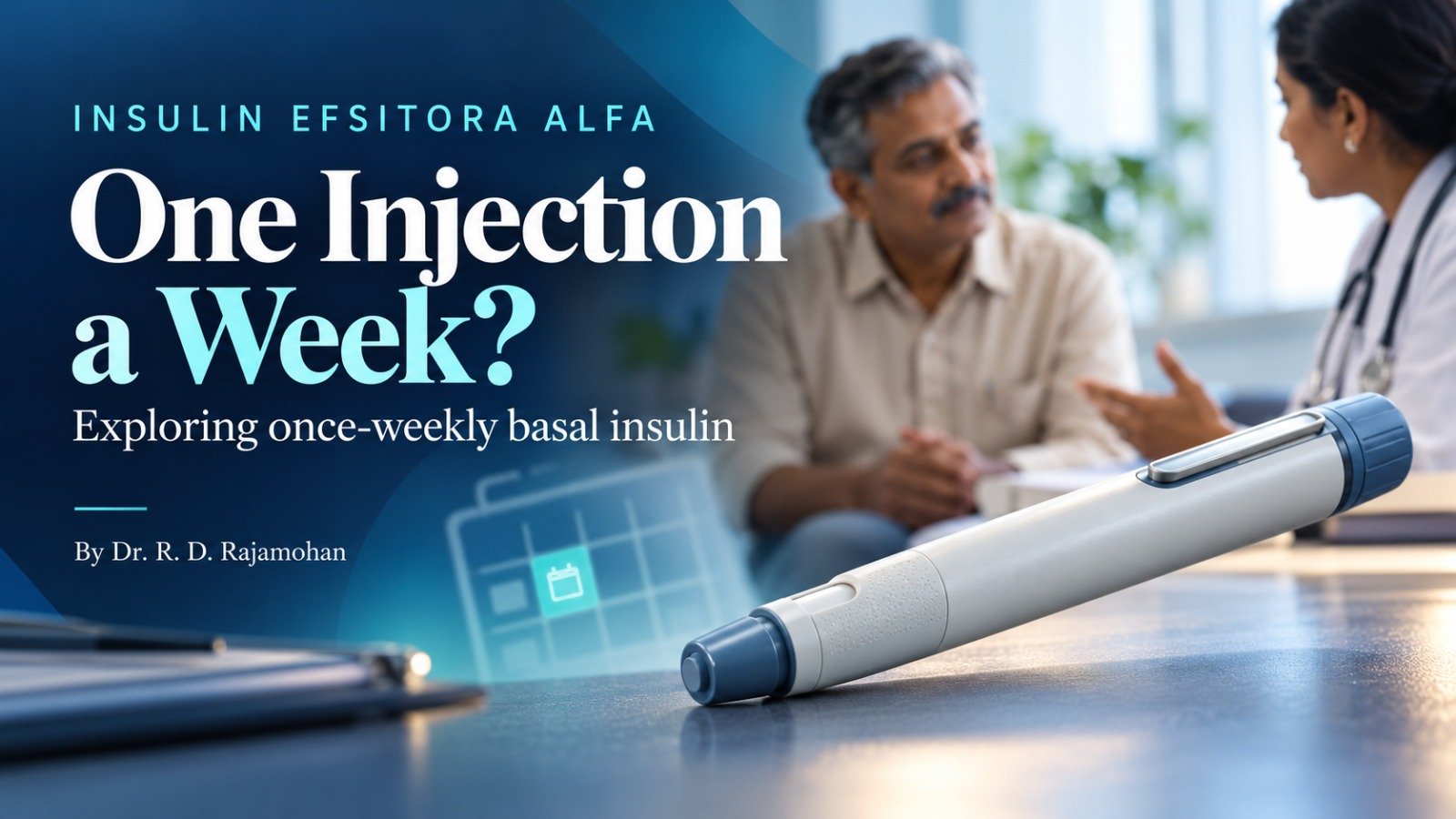
But imagine taking your long-acting insulin just once a week instead of every day.
This is the idea behind insulin efsitora alfa, a new once-weekly basal insulin developed by Eli Lilly.
It is one of the important advances being studied in modern diabetes treatment.
What Exactly Is Insulin Efsitora Alfa?
Insulin efsitora alfa is an ultra-long-acting basal insulin designed to provide background insulin coverage for an entire week.
Normally, our pancreas releases small amounts of insulin throughout the day and night, even when we are not eating.
This background insulin helps control glucose production by the liver and maintain blood glucose levels between meals and overnight.
People who require basal insulin are commonly prescribed a long-acting insulin such as insulin glargine or insulin degludec, usually administered once daily.
Efsitora has been developed to provide similar background insulin coverage with a single injection every seven days.
How Can One Injection Work for Seven Days?
Efsitora uses a specially engineered insulin molecule fused to an Fc protein component.
This modification allows the insulin to remain in circulation for a much longer period and produce a prolonged glucose-lowering effect.
Instead of requiring another basal insulin injection the following day, efsitora is designed to provide sustained insulin activity throughout the week.
Its half-life is approximately 17 days, allowing a once-weekly dosing schedule after appropriate initiation and titration.
This does not mean the insulin works for only seven days or disappears from the body after a week. Its prolonged persistence is also why careful dosing is essential.
What Have Clinical Trials Shown?
Insulin efsitora alfa has been evaluated in the QWINT clinical trial programme, which studied its effectiveness and safety in people with type 2 diabetes.
One important question was whether taking basal insulin once weekly could control blood glucose as effectively as taking it every day.
The studies demonstrated that efsitora could achieve HbA1c reductions comparable to established daily basal insulin treatments in the populations studied.
This is encouraging because it suggests that reducing injection frequency does not necessarily mean compromising glucose control.
However, results depend on the individual trial, comparator insulin, background medication and patient characteristics.
What Are the Potential Benefits?
- Fewer Insulin Injections
This is perhaps the most obvious advantage.
A person taking basal insulin every day may require approximately 365 basal injections in a year.
With once-weekly insulin, this could decrease to approximately 52.
That means around 313 fewer basal insulin injections every year.
For someone who finds daily injections burdensome, this could make a meaningful difference.
- Greater Convenience
A once-weekly injection may be easier to incorporate into a busy lifestyle.
It could be particularly appealing to people who travel frequently or find daily insulin administration inconvenient.
However, weekly dosing still requires a consistent schedule and careful medication management.
- May Reduce Hesitation About Starting Insulin
Many people with type 2 diabetes delay starting insulin because they are worried about injections.
A weekly option may make the discussion about starting insulin less intimidating for some patients.
Nevertheless, starting insulin should always depend on clinical need rather than convenience alone.
- Effective Blood Glucose Control
The QWINT trials provide evidence that efsitora can offer glucose-lowering effectiveness comparable to daily basal insulin in selected people with type 2 diabetes.
The goal remains the same: achieving individualised glucose targets while minimising hypoglycaemia and treatment burden.
Is Once-Weekly Insulin Suitable for Everyone?
Not necessarily.
Efsitora has primarily been studied as a basal insulin option in people with type 2 diabetes, although research has also evaluated it in type 1 diabetes.
Its suitability depends on several factors, including:
- Current HbA1c and blood glucose patterns
- Previous insulin treatment
- Risk of hypoglycaemia
- Other diabetes medications
- Kidney and liver health
- Ability to monitor glucose regularly
- Individual treatment goals
People with type 1 diabetes require particular caution. A once-weekly basal insulin does not replace mealtime insulin, and clinical trial findings cannot automatically be applied across all patient groups.
What About Hypoglycaemia?
Hypoglycaemia, or low blood glucose, is one of the most important safety concerns with any insulin treatment.
Symptoms can include sweating, shakiness, hunger, dizziness, palpitations and confusion.
Severe hypoglycaemia can lead to loss of consciousness or seizures.
Clinical trials of efsitora have examined hypoglycaemia carefully. In type 2 diabetes studies, the risk varied by population and treatment regimen.
Because efsitora remains active in the body for a prolonged period, incorrect dosing may have longer-lasting consequences.
Patients must never convert their daily insulin dose into a weekly dose on their own.
Initiation, switching and dose adjustments require a specific prescribing protocol and medical supervision.
Is Efsitora the Same as Weekly Semaglutide?
No. This is an important distinction.
Many people are already familiar with once-weekly diabetes injections such as semaglutide and dulaglutide.
These belong to a class of medicines called GLP-1 receptor agonists.
They are not insulin.
Efsitora is a basal insulin analogue designed to replace background insulin requirements.
The medications work through different mechanisms and are prescribed for different clinical reasons.
Does Weekly Insulin Mean Less Blood Sugar Monitoring?
No.
Even when insulin is administered once a week, blood glucose monitoring remains essential.
During treatment initiation or dose adjustment, monitoring is particularly important to identify high or low glucose levels.
Depending on the patient’s needs, this may involve finger-prick glucose testing or continuous glucose monitoring.
Once-weekly administration reduces injection frequency, not the need for responsible diabetes management.
Is Insulin Efsitora Alfa Available in India?
Efsitora has undergone an extensive clinical development programme.
Its regulatory approval and commercial availability must be checked in each country before it can be prescribed.
Patients in India should not assume that a medicine discussed in international clinical trials is already approved or available locally.
Your diabetologist can advise you about currently approved treatment options.
The Future of Insulin Treatment
Insulin treatment has changed remarkably over the years.
We have moved from older human insulin formulations to modern long-acting analogues, insulin pens, continuous glucose monitoring and increasingly personalised treatment approaches.
Once-weekly basal insulin is another step in this evolution.
For some patients, fewer injections could reduce the practical burden of treatment.
But the most important goal is not simply reducing the number of injections.
It is helping people achieve better glucose control, fewer complications and a better quality of life.
A Message from Dr. Raj Diabetes Centre
As a diabetologist, one of the common concerns I hear from patients is the difficulty of taking injections regularly.
Advances such as insulin efsitora alfa are encouraging because they may offer more convenient treatment options in the future.
However, every new treatment must be evaluated for its effectiveness, safety and suitability for the individual patient.
The best insulin is not necessarily the newest or longest-acting one. It is the insulin that helps you achieve safe, sustained glucose control with a treatment plan you can follow.
At Dr. Raj Diabetes Centre, we believe in keeping patients informed about advances in diabetes care while ensuring that treatment decisions remain evidence-based and individualised.
Better treatment options. Better understanding. Better diabetes care.
Let’s Discuss
Would you prefer a once-weekly basal insulin injection instead of a daily injection, if it were appropriate for your diabetes treatment?
Share your thoughts in the Sugbee Community.
Medical disclaimer: This article is intended for educational purposes. Insulin efsitora alfa should be used only where approved and prescribed by a qualified healthcare professional. Never change your insulin dose, frequency or type without medical supervision.